The Three-Platform Problem in Enterprise AI
- English
- Español
- 中文
- हिन्दी
- Português
- Français
- Deutsch
- 日本語
- 한국어
Enterprise AI has a platform problem. The tools to build AI-powered applications exist, but they’re scattered across three disconnected ecosystems—each solving part of the puzzle, none providing a complete solution.
This isn’t a “too many choices” problem. It’s an architectural one. Gartner tracks these ecosystems in separate Magic Quadrants because they serve fundamentally different users with different needs. But building production AI applications requires capabilities from all three.
Three Ecosystems, Zero Integration
1. Low-Code Platforms (The Citizen Developer)
Platforms like Microsoft Power Apps, Mendix, and OutSystems let business users build applications quickly without writing code. They excel at UI, rapid prototyping, and workflow automation.
 Gartner Magic Quadrant for Enterprise Low-Code Application Platforms
What they do well: Speed to prototype, accessibility for non-developers, business process automation.
What they lack: Infrastructure control, enterprise governance at scale, and the flexibility professional developers need.
2. DevOps Platforms (The Professional Developer)
GitLab, Microsoft Azure DevOps, and Atlassian provide CI/CD pipelines, source control, and deployment infrastructure. They answer the “how do we ship and operate this reliably?” question.
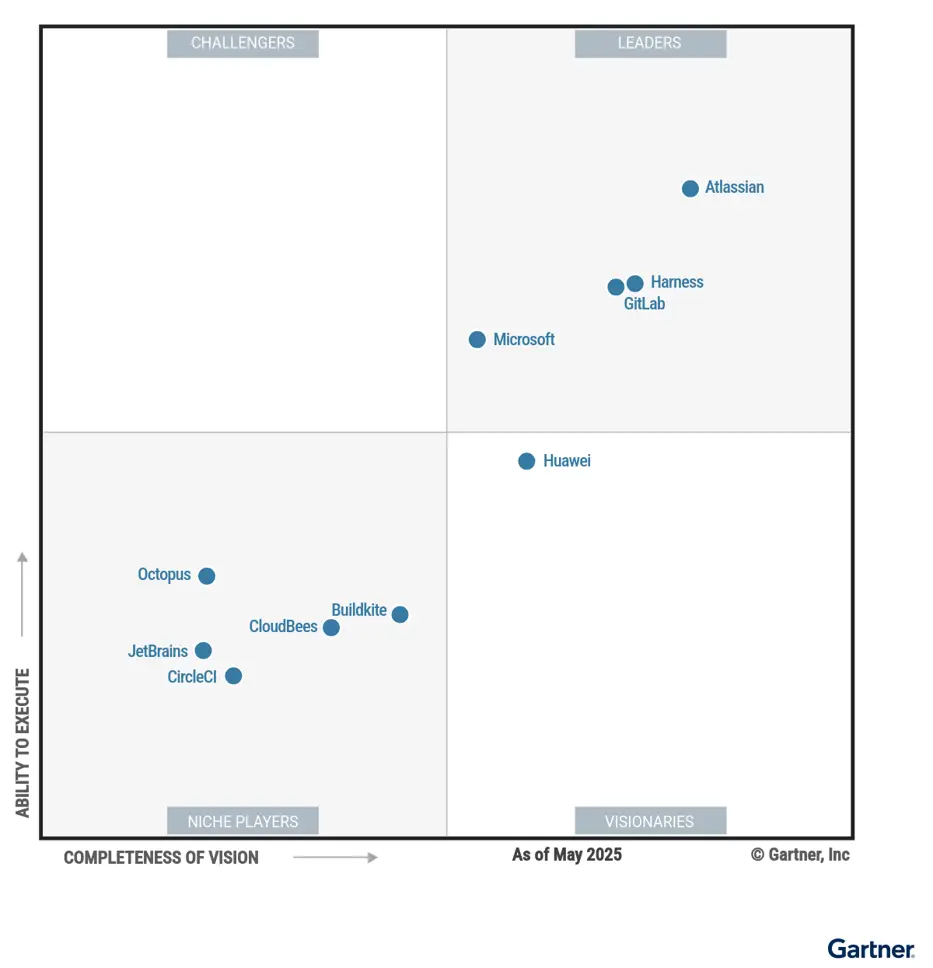 Gartner Magic Quadrant for DevOps Platforms
What they do well: Security, governance, testing, deployment automation, operational excellence.
What they lack: They don’t help you build faster—they help you ship what you’ve already built.
3. AI/ML Platforms (The AI Specialist)
Cloud providers (AWS, GCP, Azure) and specialized vendors offer models, MLOps tooling, and inference infrastructure. They provide the intelligence layer.
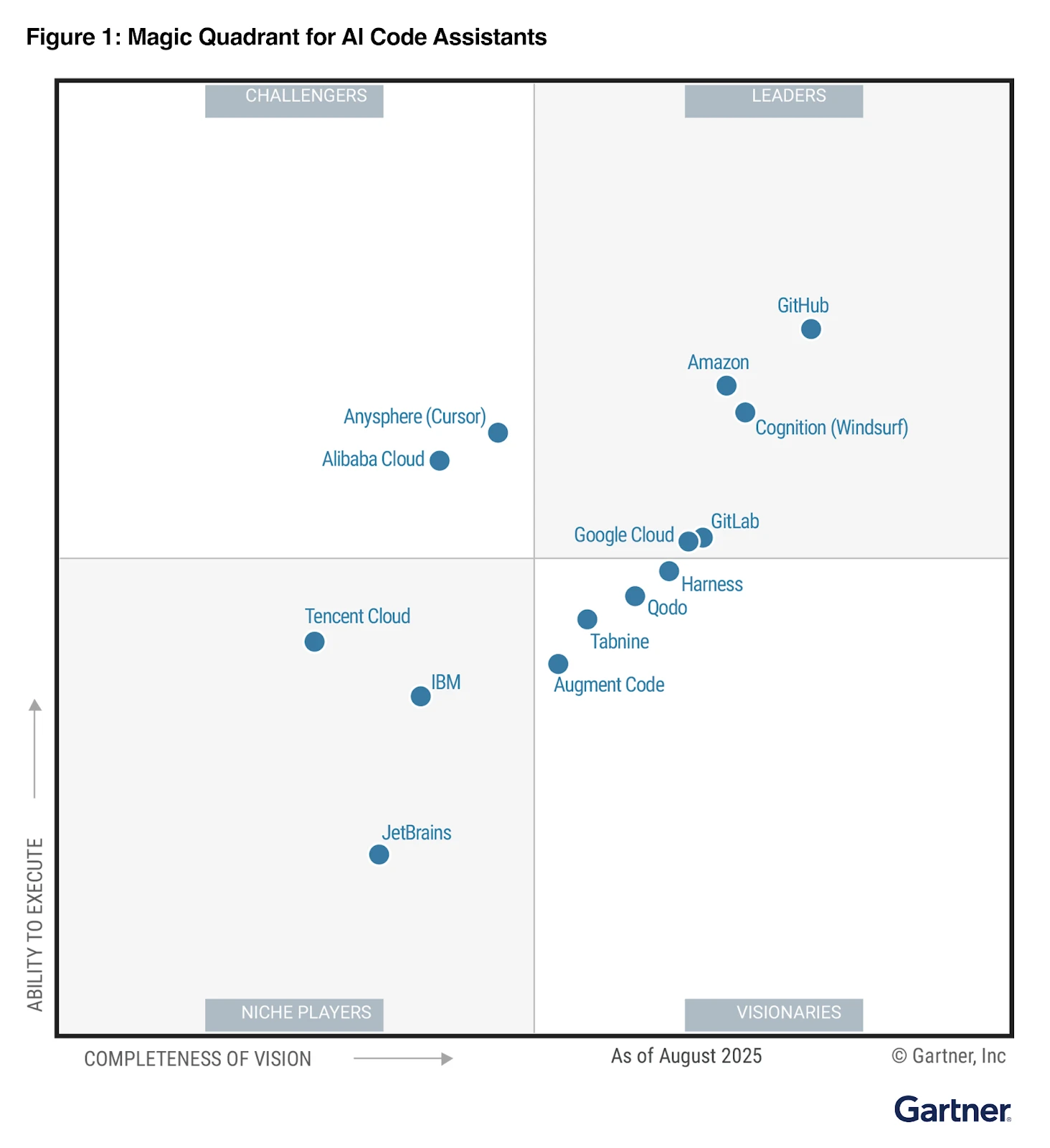 Gartner Magic Quadrant for AI Code Assistants
What they do well: Model access, training infrastructure, inference at scale.
What they lack: An opinion on how you actually build and deploy applications around those models.
The Cost of Fragmentation
When your AI strategy requires stitching together leaders from three separate ecosystems, you pay an integration tax:
Workflow disconnects. A business user prototypes an AI workflow in a low-code tool. A developer rebuilds it from scratch to meet security requirements. The prototype and production system share nothing but a spec document.
Observability gaps. Tracing a user request through a low-code UI, into a DevOps pipeline, through an AI model call, and back is nearly impossible without custom instrumentation.
Governance drift. Security policies enforced in your DevOps platform don’t automatically apply to your low-code environment. Compliance becomes a manual audit.
Your most capable engineers end up writing glue code instead of building products.
A Different Architecture: API-First Unification
The solution isn’t better integrations—it’s platforms built on a different architecture.
Replit offers a useful case study. They’ve grown from $10M to $100M ARR in under six months by building a platform where:
-
The same infrastructure serves both citizen developers and professionals. A business user building through natural language (“create a customer feedback dashboard”) and a developer writing code are using the same underlying APIs, the same deployment system, the same security model.
-
AI is native, not bolted on. Their Agent can build, test, and deploy complete applications autonomously—but it’s using the same environment a professional developer would use. No “export to production” step.
-
Governance applies universally. Database access, API key management, and deployment policies are platform-level concerns. They apply whether you’re prompting an AI agent or writing TypeScript.
This is the “headless-first” pattern that companies like Stripe and Twilio proved out: build the API, make it excellent, then layer interfaces on top. The UI for non-developers and the API for developers are just different clients to the same system.
What This Means for Platform Strategy
If you’re evaluating AI platforms, the question isn’t “which low-code tool, which DevOps platform, and which AI vendor?”
The better question: Does this platform unify these concerns, or will we be writing integration code for the next three years?
Look for:
-
API-first architecture. Can professional developers access everything through APIs? Is the UI built on those same APIs?
-
Built-in deployment and operations. Does prototyping in the platform give you production-ready infrastructure, or does it give you an export button and a prayer?
-
Platform-level governance. Are security, compliance, and cost controls configured once and inherited everywhere, or are they per-tool?
The platforms winning in this space aren’t the ones with the longest feature lists. They’re the ones that recognized the three-ecosystem problem and architected around it from day one.
Stay in the loop
Get bi-weekly insights on AI agents, SaaS strategy, and the future of software - straight to your inbox.
You're subscribed! Check your inbox soon.
Related Posts
The SaaSpocalypse: A Survival Guide
Nearly $1 trillion wiped from software stocks in a week. This is not a mass extinction—it's a cleansing fire. Here's...
2026: The Year SaaS Disappeared Into the Conversation
SaaS is shifting from dashboards and clicks to personalized, voice-enabled AI agents that execute outcomes. In 2026, the winning software...
OpenClaw and the Rise of User-Built Intelligence: A Wake-Up Call for SaaS
OpenClaw has exploded in popularity with over 114,000 GitHub stars in just two months. It represents a fundamental shift in...
The Agentic Workspace: A Strategic Imperative for the Next Era of SaaS
Traditional SaaS is under siege from AI agents. The winners won't just add AI features—they'll become agentic workspaces that orchestrate...