From Boom to Build-Out: The State of Enterprise AI in 2026
- English
- Español
- 中文
- हिन्दी
- Português
- Français
- Deutsch
- 日本語
- 한국어
The era of AI experimentation is over. What began as a speculative boom has rapidly industrialized into the fastest-scaling software category in history. According to a new report from Menlo Ventures, enterprise spending on generative AI skyrocketed to $37 billion in 2025, a stunning 3.2x increase from the previous year [3]. This isn’t just hype; it’s a fundamental market shift. AI now commands 6% of the entire global SaaS market—a milestone reached in just three years [3].
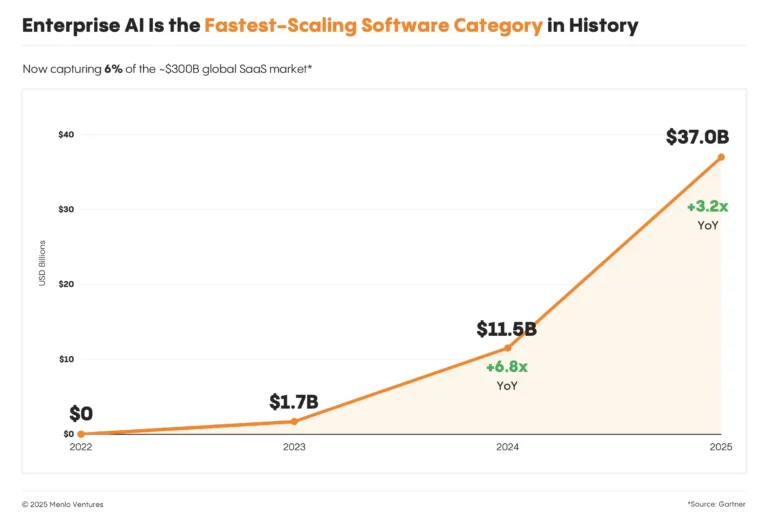
This explosive growth signals a new phase of enterprise adoption. The conversation has moved beyond simple chatbots and one-off tasks to focus on building durable, agentic infrastructure. Reports from OpenAI, Anthropic, and Menlo Ventures all point to the same conclusion: the battleground for competitive advantage has shifted from model performance to platform execution.
The Money Flows to Applications, and Enterprises are Buying
So, where is this money going? Over half of all enterprise AI spend $19 billion is flowing directly into the application layer [3]. This indicates a clear preference for immediate productivity gains over long-term, in-house infrastructure projects. The “buy vs. build” debate has decisively tilted towards buying, with 76% of AI use cases now being purchased from vendors, a dramatic reversal from 2024 when the split was nearly even [3].
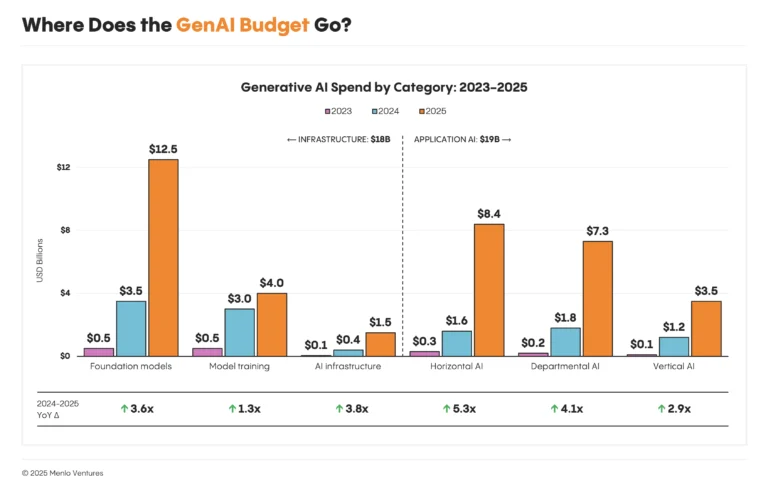
This trend is fueled by two factors: AI solutions are converting at nearly double the rate of traditional SaaS (47% vs. 25%), and product-led growth (PLG) is driving adoption at 4x the rate of traditional software [3]. Individual employees and teams are adopting AI tools, proving their value, and creating a powerful bottom-up flywheel that short-circuits legacy procurement cycles.
The Architectural Shift: From Queries to Agentic Workflows
This rapid adoption is not just about doing old tasks faster; it’s about enabling entirely new ways of working. The data shows a clear architectural shift from simple, conversational queries to structured, agentic workflows that are deeply embedded in core business processes.

Anthropic’s 2026 survey reveals that 57% of organizations are already deploying agents for multi-stage processes, with 81% planning to tackle even more complex, cross-functional workflows in the coming year [1]. This transition from single-turn interactions to persistent, multi-step agents is where true business transformation is happening.
OpenAI’s 2025 report highlights a 19x year-to-date increase in the use of structured workflows like Custom GPTs and Projects, with 20% of all enterprise messages now being processed through these repeatable systems [2]. The impact is tangible, with 80% of organizations reporting measurable ROI on their agent investments and workers saving an average of 40-60 minutes per day [1, 2].
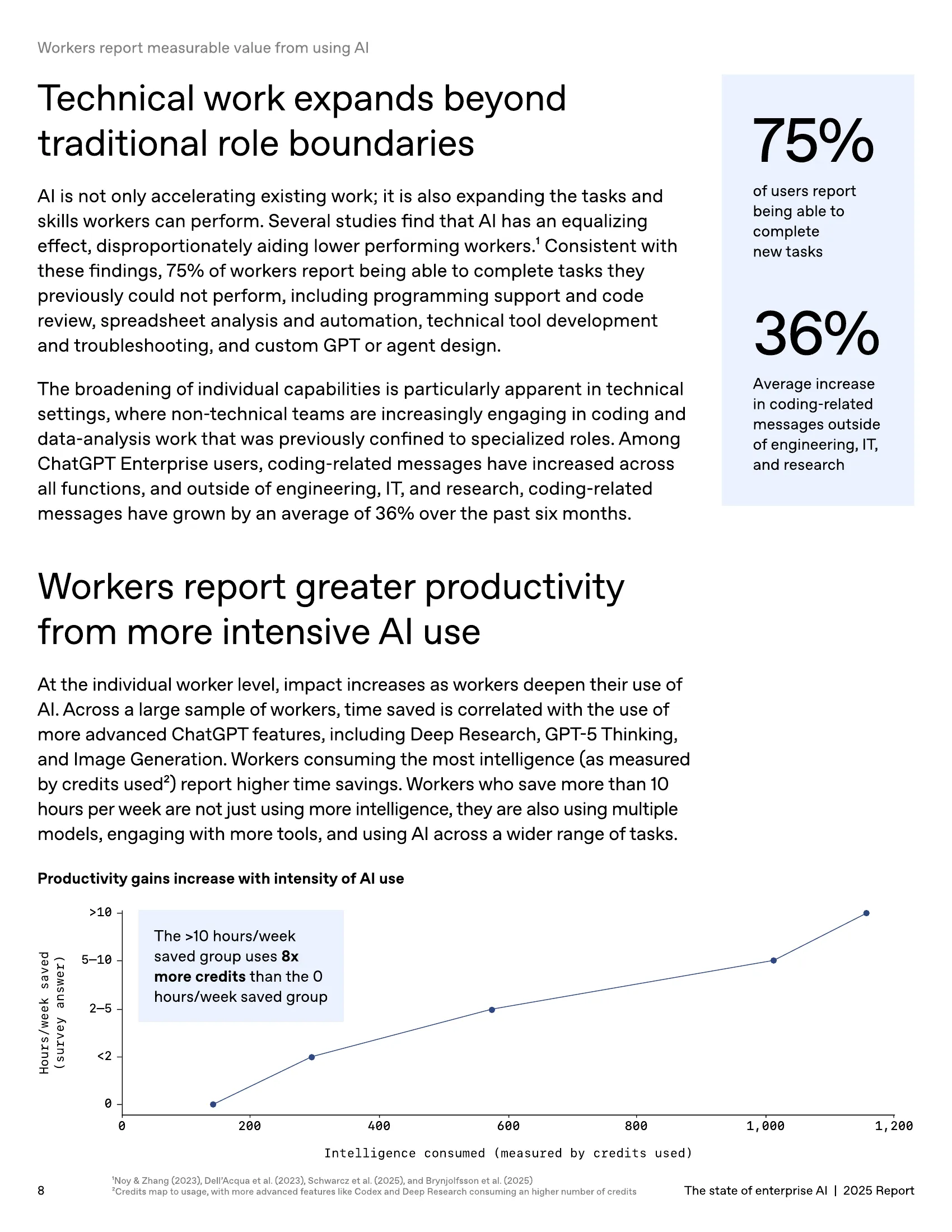
Perhaps most striking is that 75% of workers report being able to complete tasks they previously could not perform, including programming support, spreadsheet analysis, and technical tool development [2]. This democratization of technical capabilities is fundamentally reshaping how work gets done.
Coding Leads the Charge
Nearly all organizations (90%) now use AI to assist with development, and 86% deploy agents for production code [1]. The adoption is so pervasive that coding-related messages have increased by 36% even among non-technical workers [2].
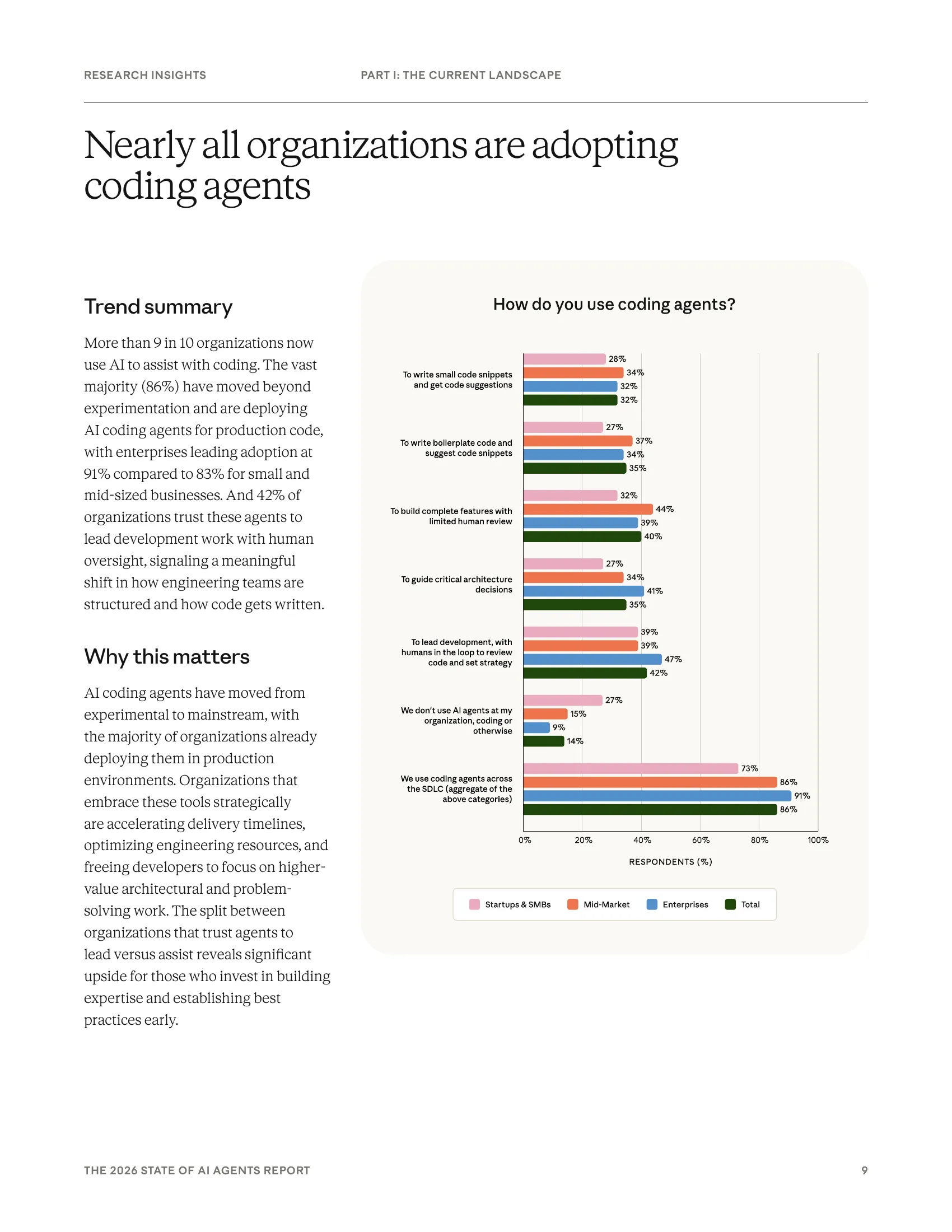
Organizations report time savings across the entire development lifecycle: planning and ideation (58%), code generation (59%), documentation (59%), and code review and testing (59%) [1]. This systematic integration across the full software development lifecycle is accelerating delivery timelines and freeing developers to focus on higher-value architectural and problem-solving work.
The New Frontier: Platform-Level Execution
As AI becomes an essential, intelligent layer of the enterprise tech stack, the primary barriers to scaling are no longer model capabilities but organizational and architectural readiness. The top challenges cited by leaders are integration with existing systems (46%), data access and quality (42%), and change management (39%) [1]. These are not model problems; they are platform problems.
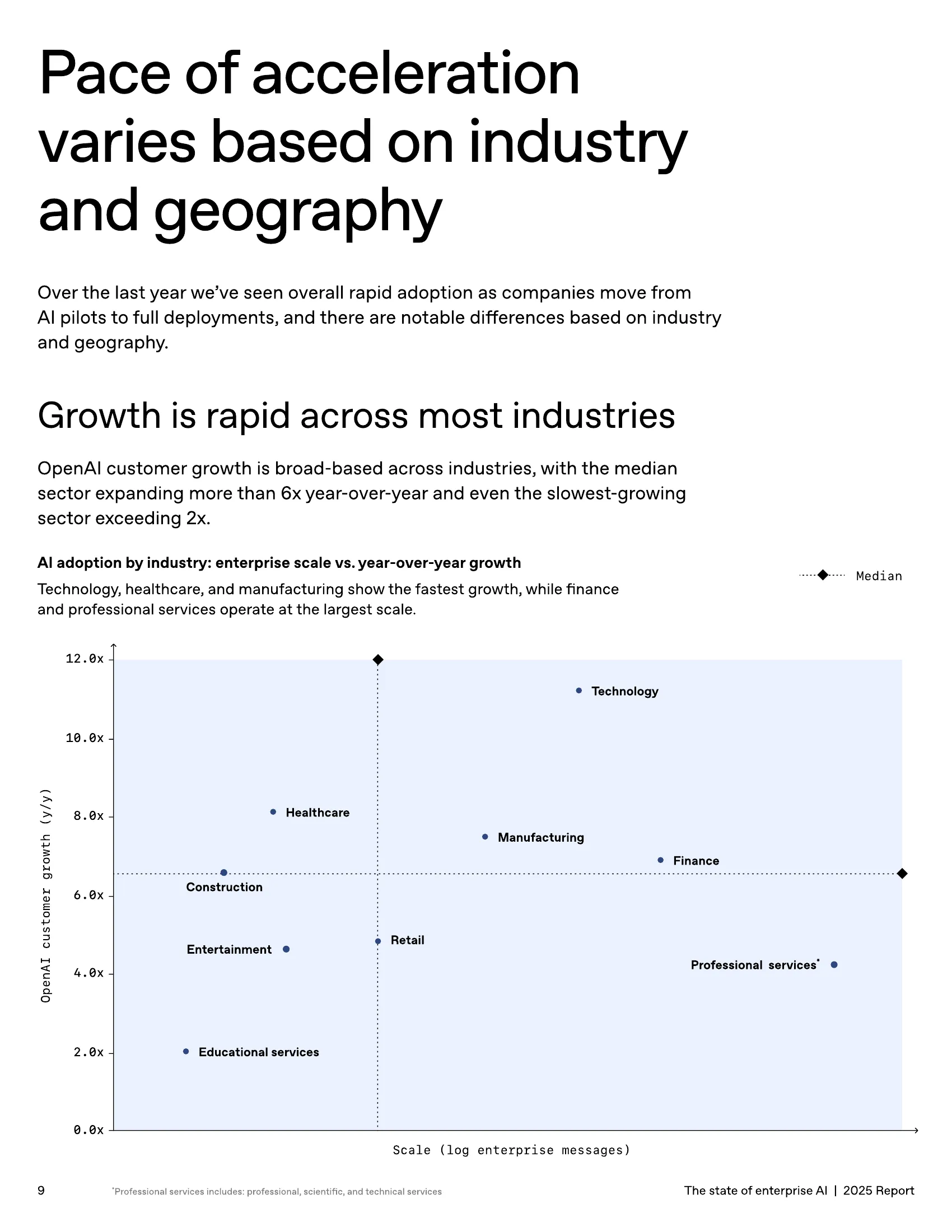
This new reality is creating a widening performance gap. OpenAI’s data shows that “frontier firms” that treat AI as integrated infrastructure see 2x more engagement per seat, and their workers are 6x more active than the median [2]. Technology, healthcare, and manufacturing are seeing the fastest growth (11x, 8x, and 7x respectively), while professional services and finance operate at the largest scale [2].
The state of enterprise AI in 2026 is clear: the gold rush is over, and the era of building the railroads has begun. Success is no longer defined by having the best model, but by having the best platform to deploy, manage, and secure intelligence at scale.
References:
[1] Anthropic. (2025). The 2026 State of AI Agents Report. Anthropic.
[2] OpenAI. (2025). The state of enterprise AI 2025 report. OpenAI.
Stay in the loop
Get bi-weekly insights on AI agents, SaaS strategy, and the future of software - straight to your inbox.
You're subscribed! Check your inbox soon.
Related Posts
The SaaSpocalypse: A Survival Guide
Nearly $1 trillion wiped from software stocks in a week. This is not a mass extinction—it's a cleansing fire. Here's...
2026: The Year SaaS Disappeared Into the Conversation
SaaS is shifting from dashboards and clicks to personalized, voice-enabled AI agents that execute outcomes. In 2026, the winning software...
OpenClaw and the Rise of User-Built Intelligence: A Wake-Up Call for SaaS
OpenClaw has exploded in popularity with over 114,000 GitHub stars in just two months. It represents a fundamental shift in...
The Agentic Workspace: A Strategic Imperative for the Next Era of SaaS
Traditional SaaS is under siege from AI agents. The winners won't just add AI features—they'll become agentic workspaces that orchestrate...