2025: The Year Agentic AI Got Real (What Comes Next)
If 2024 was the year of AI experimentation, 2025 was the year of industrialization. The speculative boom around generative AI has rapidly matured into the fastest-scaling software category in history, with autonomous agents moving from the lab to the core of enterprise operations. As we close out the year, it’s clear that the agentic AI landscape has been fundamentally reshaped by massive investment, critical standardization, and a clear-eyed focus on solving the hard problems of production readiness.
But this wasn’t just a story of adoption. 2025 was the year the industry confronted the architectural limitations of monolithic agents and began a decisive shift toward a more specialized, scalable, and governable future.
The $37 Billion Build-Out: From Experiment to Enterprise Imperative
The most telling sign of this shift is the sheer volume of capital deployed. According to a December 2025 report from Menlo Ventures, enterprise spending on generative AI skyrocketed to $37 billion in 2025, a stunning 3.2x increase from the previous year [1]. This surge now accounts for over 6% of the entire global software market.
Crucially, over half of this spending ($19 billion) flowed directly into the application layer, demonstrating a clear enterprise priority for immediate productivity gains over long-term infrastructure bets. This investment is validated by strong adoption metrics, with a recent PwC survey finding that 79% of companies are already adopting AI agents [2].
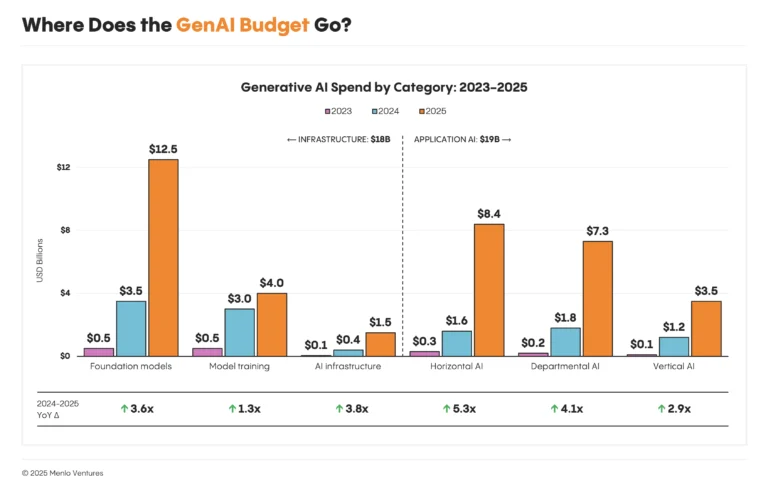 Source: Menlo Ventures, 2025: The State of Generative AI in the Enterprise [1]
Solving the Interoperability Crisis: The Standardization of 2025
While the spending boom captured headlines, a quieter, more profound revolution was taking place in the infrastructure layer. The primary challenge addressed in 2025 was the interoperability crisis. The early agentic ecosystem was a chaotic landscape of proprietary APIs and fragmented toolsets, making it nearly impossible to build robust, cross-platform applications. This year, two key developments brought order to that chaos.
1. The Maturation of MCP
The Model Context Protocol (MCP), introduced in late 2024, became the de facto standard for agent-to-tool communication. Its first anniversary in November 2025 was marked by a major spec release that introduced critical enterprise features like asynchronous operations, server identity, and a formal extensions framework, directly addressing early complaints about its production readiness [3].
This culminated in the December 9th announcement that Anthropic, along with Block and OpenAI, was donating MCP to the newly formed Agentic AI Foundation (AAIF) under the Linux Foundation [4]. With over 10,000 active public MCP servers and 97 million monthly SDK downloads, MCP’s transition to a neutral, community-driven standard solidifies its role as the foundational protocol for the agentic economy.
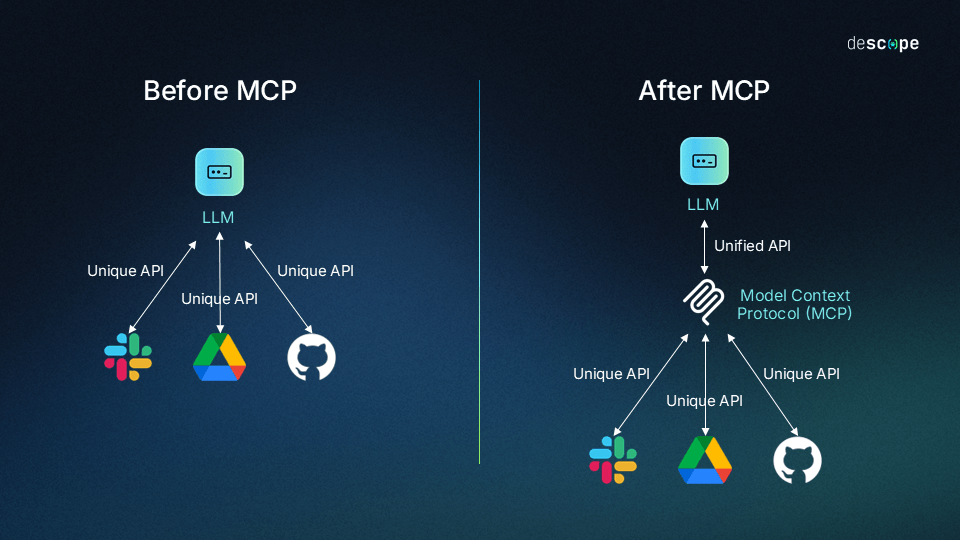 The shift from fragmented, proprietary APIs to a unified, MCP-based approach simplifies agent-tool integration.
2. The Dawn of Portable Skills
Following the same playbook, Anthropic made another pivotal move on December 18th, opening up its Agent Skills specification [5]. This provides a standardized, portable way to equip agents with procedural knowledge, moving beyond simple tool-use to more complex, multi-step task execution. By making the specification and SDK available to all, the industry is fostering an ecosystem where skills can be developed, shared, and deployed across any compliant AI platform, preventing vendor lock-in.
The Next Frontier: The Rise of the Agent Workforce
These standardization efforts have unlocked the next major architectural shift: the move away from monolithic, general-purpose agents toward collections of specialized skills that function like a human team. No company hires a single “super-employee” to be a marketer, an engineer, and a financial analyst. They hire specialists who excel at their roles and collaborate to achieve a larger goal. The future of enterprise AI is the same.
This “multi-agent” or “skill-based” architecture is not just a theoretical concept. Anthropic’s own research showed that a multi-agent system—with a lead agent coordinating specialized sub-agents—outperformed a single, more powerful agent by over 90% on complex research tasks [6]. The reason is simple: specialization allows for greater accuracy, and parallelism allows for greater scale.
We are already seeing the first wave of companies built on this philosophy. YC-backed Getden.io, for example, provides a platform for non-engineers to build and collaborate with agents that can be composed of various skills and integrations [7]. This approach democratizes agent creation, allowing domain experts—not just developers—to build the specialized “digital employees” they need.
The Challenges of 2026: From Adoption to Governance
While 2025 solved the problem of connection, 2026 will be about solving the challenges of control and coordination at scale. As enterprises move from deploying dozens of agents to thousands of skills, a new set of problems comes into focus:
-
Governance at Scale: How do you manage access control, cost, and versioning for thousands of interconnected skills? The risk of “skill sprawl” and shadow AI is immense, demanding a new generation of governance platforms.
-
Reliability and Predictability: The non-deterministic nature of LLMs remains a major barrier to enterprise trust. For agents to run mission-critical processes, we need robust testing frameworks, better observability tools, and architectural patterns that ensure predictable outcomes.
-
Multi-Agent Orchestration: As skill-based systems become the norm, the primary challenge shifts from tool-use to agent coordination. How do you manage dependencies, resolve conflicts, and ensure a team of agents can reliably collaborate to complete a complex workflow? This is a frontier problem that will define the next generation of agentic platforms.
-
Security in a Composable World: A world of interoperable skills creates new attack surfaces. How do you secure the supply chain for third-party skills? How do you prevent a compromised agent from triggering a cascade of failures across a complex workflow? The security model for agentic AI is still in its infancy.
The groundwork laid in 2025 was monumental. It moved us from a world of isolated, experimental bots to the brink of a true agentic economy. But the journey is far from over. The companies that will win in 2026 and beyond will be those that master the art of building, managing, and securing not just agents, but entire workforces of specialized, collaborative skills.
References:
[2] PwC. (2025, May 16). PwC’s AI Agent Survey. PwC.
[6] Anthropic. (2025, June 13). How we built our multi-agent research system. Anthropic Engineering.
[7] Y Combinator. (2025). Den: Cursor for knowledge workers. Y Combinator.