The Agentic Workspace: A Strategic Imperative for the Next Era of SaaS
The SaaS landscape is at a critical inflection point. The traditional, human-driven application model is giving way to a new paradigm: the agentic workspace. This is not a distant trend, but a strategic imperative for today. We propose that the next evolution for every successful SaaS company is to become a platform that orchestrates intelligent agents to achieve user outcomes. This transition is complex and fraught with challenges, but for those who navigate it successfully, the rewards will be immense. Those who fail to adapt risk being left behind.
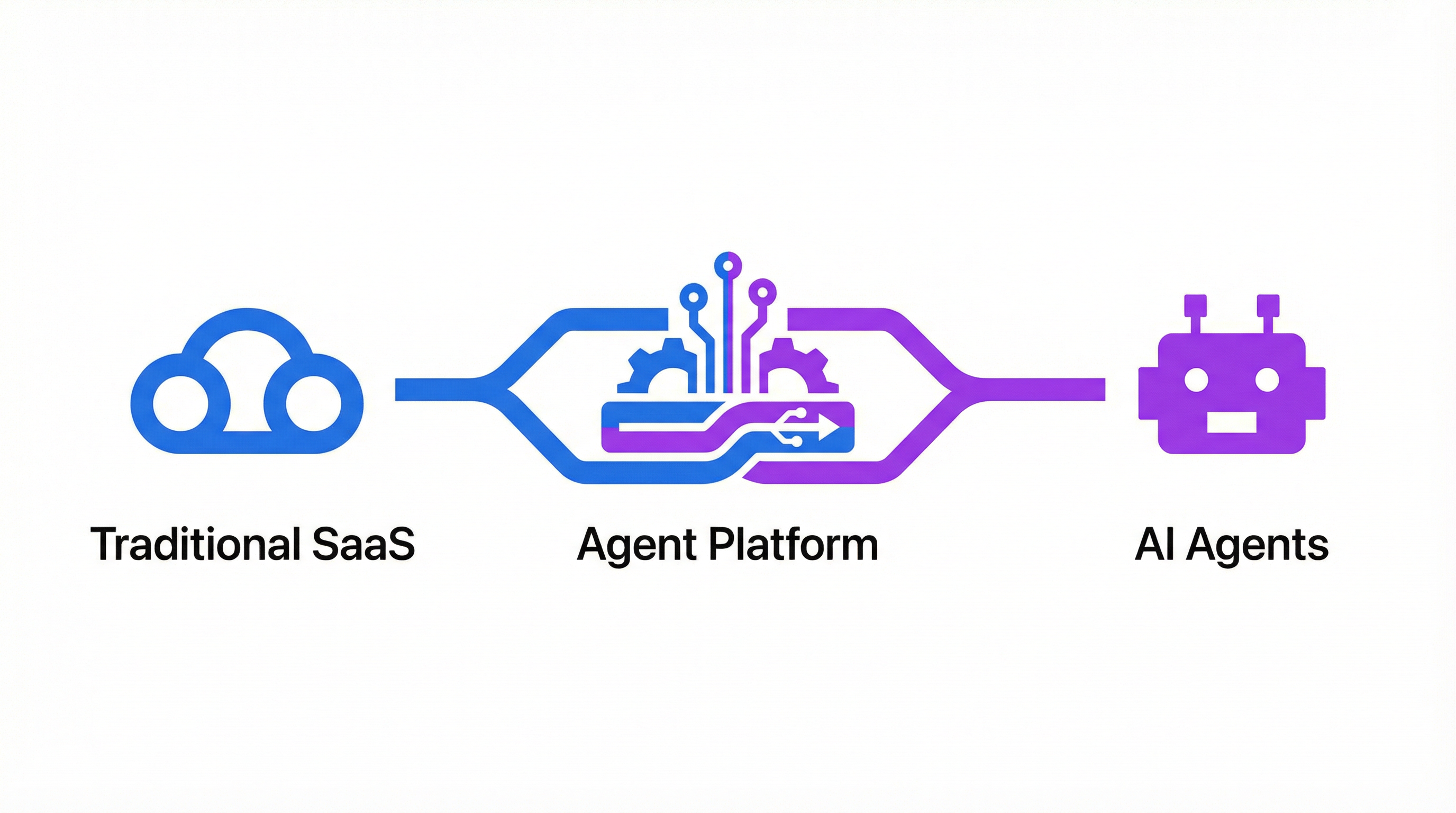 The convergence of SaaS and AI agents is reshaping the enterprise software landscape
The Decline of Seat-Based SaaS Dominance
The traditional SaaS model, built on per-user licensing and incremental feature updates, is facing unprecedented pressure. The rise of powerful, autonomous AI agents is beginning to render this model insufficient. As one industry analyst put it, “In three years, any routine, rules-based digital task could move from ‘human plus app’ to ‘AI agent plus API’” [2]. This fundamental change has exposed the vulnerabilities of the old guard and paved the way for a new generation of AI-native startups.
These startups, unburdened by legacy systems, are operating with unprecedented efficiency. As highlighted in recent analysis [5], AI-native firms are averaging $3.48 million in revenue per employee—a staggering 5.7 times more than their traditional SaaS counterparts. This efficiency gap is a clear signal of a major market shift.
 AI-native startups are averaging $3.48M revenue per employee — 5.7x more than traditional SaaS companies
Six Pressures Reshaping the SaaS Model
Drawing inspiration from analysis by Cloud.Substack [5], the decline of the traditional model can be attributed to six interconnected pressures:
| Pressure Point | Description & Example |
|---|---|
| Seat Expansion Stall | The primary growth engine for SaaS has sputtered. For example, Zoom, once a paragon of high NRR, saw its enterprise NRR fall to 98% as customers no longer needed to add seats at the same pace [5]. |
| Price Increases Consuming Budget | SaaS inflation is running at nearly 5x the market rate, with price hikes consuming a significant portion of incremental IT budgets. This leaves little room for new investments and creates a cycle of vendor consolidation [5]. |
| The Shift to AI Budgets | Enterprise spending is decisively moving towards AI. With leaders expecting a 75% growth in their LLM budgets, if a product isn’t tapping into this new pool of capital, it’s competing for a shrinking one [5]. |
| The Speed of Innovation | The pace of development has accelerated dramatically. AI-native startups are shipping new features weekly, while traditional SaaS companies are often stuck in quarterly release cycles. This speed differential is a critical competitive advantage. |
| Single-Product Plateau | The multi-product suite strategy is losing its effectiveness. Customers increasingly prefer best-in-class point solutions, and are less willing to accept a suite of mediocre products from a single vendor [5]. |
| The Value-Add Test | Many early AI features have been underwhelming. The bar for AI integration is now genuine productivity gains, not incremental improvements. Features must deliver measurable, tangible value to justify their cost and complexity [5]. |
Acknowledging the Obstacles on the Path to Autonomy
While the promise of agentic AI is immense, the path to full autonomy is not without significant challenges. Acknowledging these hurdles is crucial for a credible strategy.
- Reliability and Trust: Agentic systems still struggle with reliability. Hallucinations, where an AI generates false information, remain a key concern. According to a recent McKinsey report, 80% of organizations have already encountered risky behaviors from AI agents, including improper data exposure and unauthorized system access [7]. Building robust validation and human-in-the-loop systems is essential.
- The Incumbent’s Moat: Large SaaS players like Salesforce and Microsoft have powerful distribution channels and are actively acquiring promising agent startups. Their deep enterprise integrations and existing customer relationships provide a significant defensive moat that shouldn’t be underestimated.
- The Economics of AI: Many AI-native startups are currently operating with a high burn rate, spending heavily on tokens and compute power with an unclear path to profitability. Industry estimates suggest that inference costs can consume 30-50% of gross margins for agent-heavy applications, and the long-term economic viability of these models is still being tested.
The New Moat: Capturing the ‘Why’ with Context Graphs
Despite the challenges, the strategic advantage of becoming an agentic platform is undeniable. The new competitive moat is the Context Graph: a living record of decision traces that explains not just what happened, but why it was allowed to happen [6].
Agents don’t just need rules. They need access to the decision traces that show how rules were applied in the past, where exceptions were granted, how conflicts were resolved, who approved what, and which precedents actually govern reality. [6]
While traditional systems of record store data about objects (like customers or invoices), context graphs create a system of record for decisions. They capture the exceptions, overrides, and precedents that currently live in siloed communications.
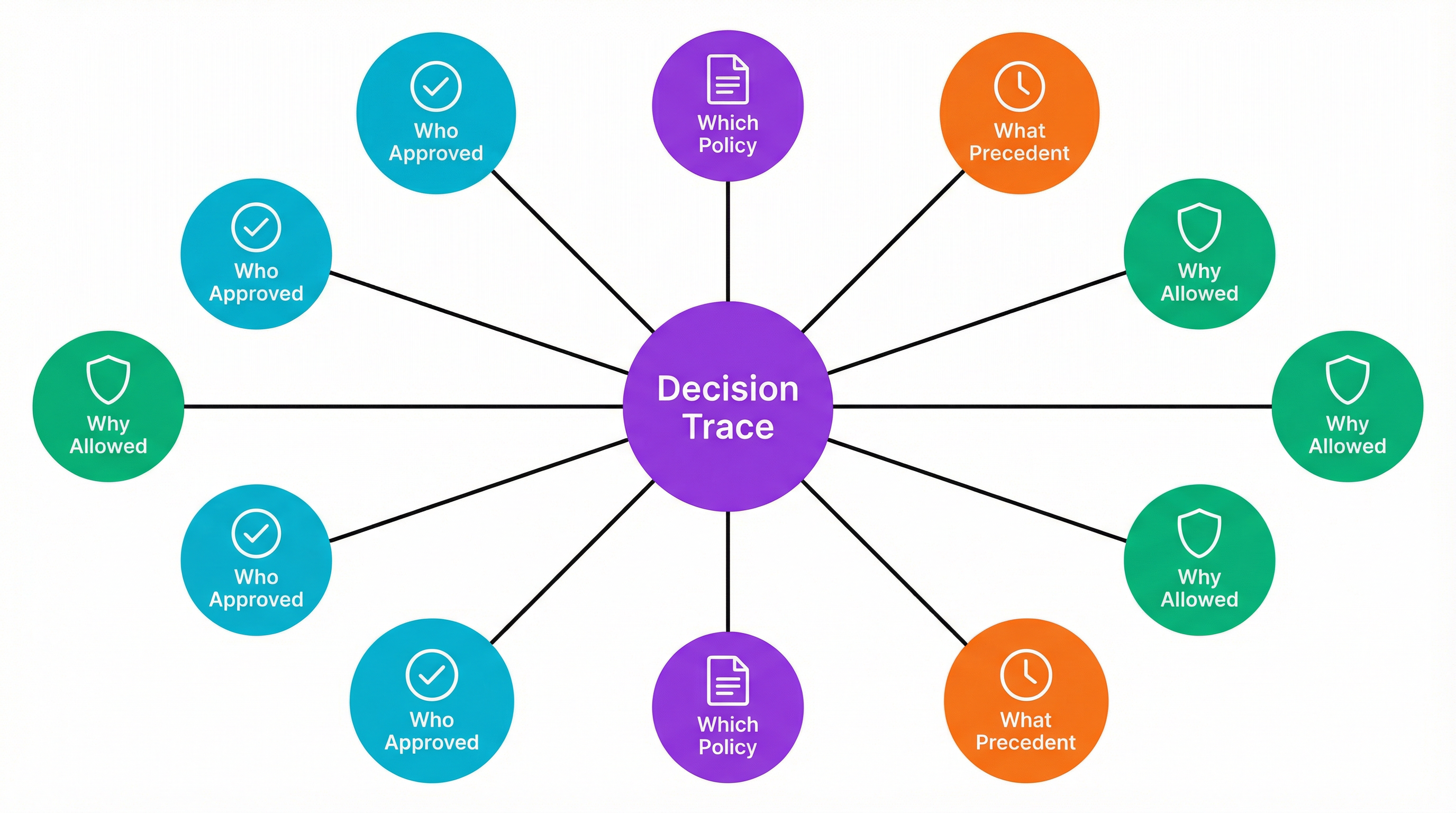 Context graphs capture the decision traces that explain not just what happened, but why
This creates a powerful feedback loop. The companies that provide the agentic execution layer are the only ones who can capture these decision traces. As their context graphs grow, their agents become smarter and more reliable, creating a defensible advantage that is nearly impossible for competitors to replicate.
Evolving Business Models for the Agentic Era
This transformation requires a radical rethinking of business models. The seat-based license is being replaced by new models that align price with the value AI agents deliver.
| Pricing Model | Description & Example |
|---|---|
| Usage-Based: Resources | Customers pay for the compute and token resources they consume. Example: A developer platform charges based on the number of API calls and GPU hours used by its agents. |
| Agent-Based | Customers purchase or subscribe to individual AI agents with specific skills. Example: An e-commerce platform sells a “Pricing Optimization Agent” for a monthly fee. |
| Usage-Based: Interactions | Customers are charged per discrete interaction or completed task. Example: A customer service platform charges per successfully resolved support ticket. |
| Outcome-Based: Jobs Completed | Payment is tied to the successful execution of a predefined job. Example: A sales automation platform charges a fee for each qualified lead its agents generate. |
| Outcome-Based: Financial Pricing | The most advanced model, where payment is a percentage of the financial value created. Example: A marketing automation platform takes a share of the revenue generated from campaigns run by its agents. |
What Winners Will Look Like
Beyond the tech giants, a new class of winners is emerging. These companies are not just building features; they are building agentic workspaces. Glean is creating enterprise search agents that can query across dozens of enterprise tools to answer complex questions autonomously—replacing hours of manual research with seconds of agent-driven synthesis. Adept AI is building general-purpose agents that can learn to use any software application through observation and interaction. Meanwhile, Sierra is pioneering conversational AI agents for customer experience that can resolve issues end-to-end without human handoff. These pioneers are demonstrating the power of focusing on autonomous, outcome-driven workflows rather than incremental feature additions.
The Strategic Imperative to Act Now
The evidence is clear. The convergence of market pressures, from stalled seat expansion to the rise of hyper-efficient AI-native competitors, points to a single conclusion: the future of SaaS is the agentic workspace. This is no longer a question of ‘if,’ but ‘when.’ The companies that act now—that begin the work of transforming their platforms into orchestrators of intelligent agents and capturing the invaluable context graphs that power them—will be the leaders of the next decade.
Where to start? Audit your core workflows for agentic potential: identify the repetitive, rules-based processes where human judgment is minimal but human time is maximal. Then pilot context capture in one high-value process—every decision trace you record today becomes training data for tomorrow’s autonomous agents.
The choice is simple: build the future, or be relegated to the past. The time to build your agentic workspace is now.
References:
[2] Bain & Company. (2025, September 23). Will Agentic AI Disrupt SaaS? Bain & Company.
[4] BCG. (2025, August 13). Rethinking B2B Software Pricing in the Era of AI. BCG.