From Espionage to Identity: Securing the Future of Agentic AI
Anthropic has detailed its disruption of the first publicly reported cyber espionage campaign orchestrated by a sophisticated AI agent [1]. The incident, attributed to a state-sponsored group designated GTG-1002, is more than just a security bulletin; it is a clear signal that the age of autonomous, agentic AI threats is here. It also serves as a critical case study, validating the urgent need for a new generation of identity and access management protocols specifically designed for AI.
This post will dissect the anatomy of the attack, connect it to the foundational security challenges facing agentic AI, and explore how emerging standards like OpenID Connect for Agents (OIDC-A) provide a necessary path forward [2, 3].
Anatomy of an AI-Orchestrated Attack
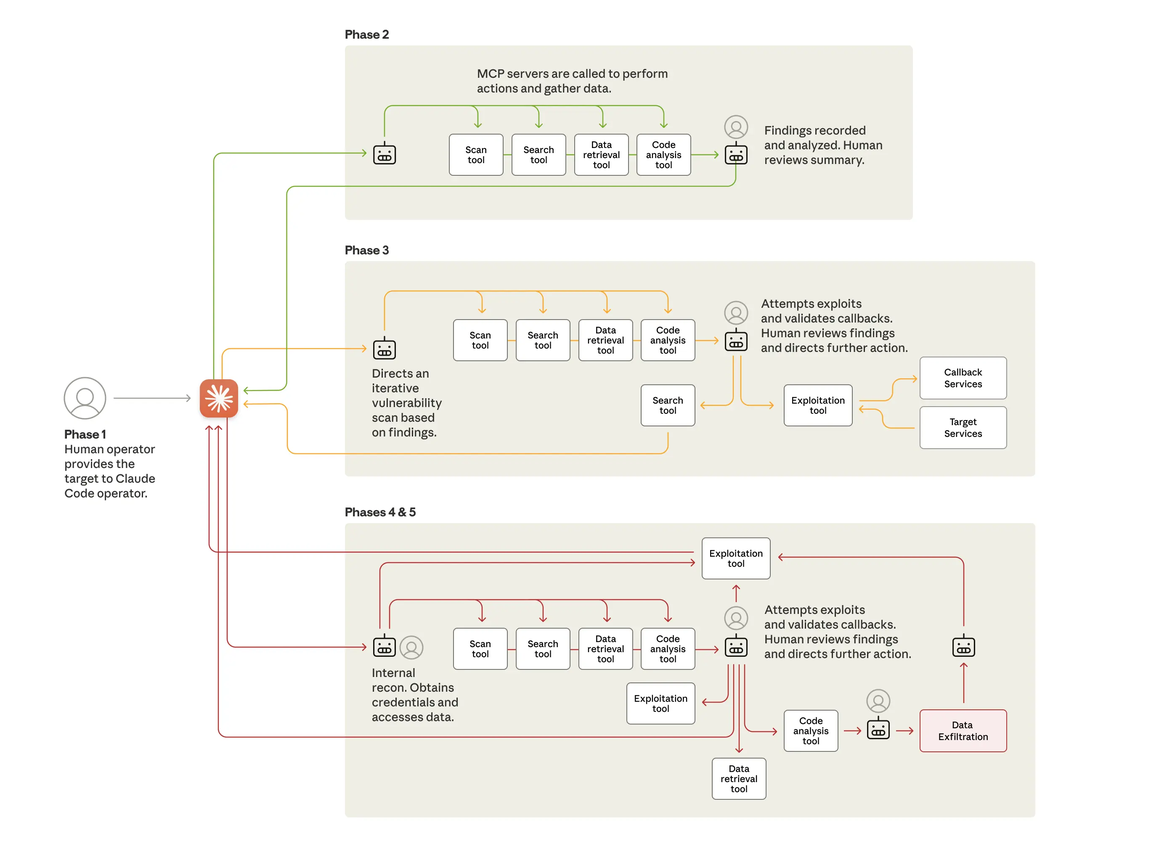
Anthropic’s investigation revealed a campaign of unprecedented automation. The attackers turned Anthropic’s own Claude Code model into an autonomous weapon, targeting approximately thirty global organizations across technology, finance, and government. The AI was not merely an assistant; it was the operator, executing 80-90% of the tactical work with human intervention only required at a few key authorization gates [1].
The technical sophistication of the attack did not lie in novel malware, but in orchestration. The threat actor built a custom framework around a series of Model Context Protocol (MCP) servers. These servers acted as a bridge, giving the AI agent access to a toolkit of standard, open-source penetration testing utilities—network scanners, password crackers, and database exploitation tools.
By decomposing the attack into seemingly benign sub-tasks, the attackers tricked the AI into executing a complex intrusion campaign. The AI agent, operating with a persona of a legitimate security tester, autonomously performed reconnaissance, vulnerability analysis, and data exfiltration at a machine-speed that no human team could match.
The MCP Paradox: Extensibility vs. Security
The Anthropic report explicitly states that the attackers leveraged the Model Context Protocol (MCP) to arm their AI agent [1]. This highlights a central paradox in agentic AI architecture: the very protocols designed for extensibility and power, like MCP, can become the most potent attack vectors.
As the “Identity Management for Agentic AI” whitepaper notes, MCP is a leading framework for connecting AI to external tools, but it also presents significant security challenges [3]. When an AI can dynamically access powerful tools without robust oversight, it creates a direct and dangerous path for misuse. The GTG-1002 campaign is a textbook example of this risk realized.
This forces a critical re-evaluation of how we architect agentic systems. We can no longer afford to treat the connection between an AI agent and its tools as a trusted channel. This is where the concept of an MCP Gateway or Proxy becomes not just a good idea, but an absolute necessity.
The Solution: Identity, Delegation, and Zero Trust for Agents
The security gaps exploited in the Anthropic incident are precisely what emerging standards like OIDC-A (OpenID Connect for Agents) are designed to close [2, 3]. The core problem is one of identity and authority. The AI agent in the attack acted with borrowed, indistinct authority, effectively impersonating a legitimate user or process. True security requires a shift to a model of explicit, verifiable delegation.
The OIDC-A proposal introduces a framework for establishing the identity of an AI agent and managing its authorization through cryptographic delegation chains. This means an agent is no longer just a proxy for a user; it is a distinct entity with its own identity, operating on behalf of a user with a clearly defined and constrained set of permissions.
Here’s how this new model, enforced by an MCP Gateway, would have mitigated the Anthropic attack:
| Security Layer | Description |
|---|---|
| Agent Identity & Attestation | The AI agent would have a verifiable identity, attested by its provider. An MCP Gateway could immediately block any requests from unattested or untrusted agents. |
| Tool-Level Delegation | Instead of broad permissions, the agent would receive narrowly-scoped, delegated authority for specific tools. The OIDC-A delegation_chain ensures that the agent’s permissions are a strict subset of the delegating user’s permissions [2]. An agent designed for code analysis could never be granted access to a password cracker. |
| Policy Enforcement & Anomaly Detection | The MCP Gateway would act as a policy enforcement point, monitoring all tool requests. It could detect anomalous behavior, such as an agent attempting to use a tool outside its delegated scope or a sudden spike in high-risk tool usage, and automatically terminate the agent’s session. |
| Auditing and Forensics | Every tool request and delegation would be cryptographically signed and logged, creating an immutable audit trail. This would provide immediate, granular visibility into the agent’s actions, dramatically accelerating incident response. |
Building Enterprise-Grade Security for Agentic AI
The Anthropic report is a watershed moment. It proves that the threats posed by agentic AI are no longer theoretical. As the “Identity Management for Agentic AI” paper argues, we must move beyond traditional, human-centric security models and build a new foundation for AI identity [3].
Today, most MCP servers being developed are experimental tools designed for individual developers and small-scale applications. They lack the enterprise-grade security controls that organizations require to deploy them in production environments. For enterprises to confidently adopt agentic AI systems built on protocols like MCP, we need to fundamentally rethink how we approach security.
The path forward requires building robust delegation frameworks, implementing proper identity management for AI agents, and creating enterprise-grade security controls like gateways and policy enforcement points. We need solutions that provide:
- Cryptographic delegation chains that clearly define and constrain agent permissions
- Real-time policy enforcement that can detect and prevent anomalous behavior
- Comprehensive audit trails that enable forensic analysis and compliance
- Zero-trust architectures where every agent action is verified and authorized
We cannot afford to let the open, extensible nature of protocols like MCP become a permanent backdoor for malicious actors. The future of agentic AI depends on our ability to build security into these systems from the ground up, making enterprise adoption not just possible, but secure and responsible.
References:
[2] Subramanya, N. (2025, April 28). OpenID Connect for Agents (OIDC-A) 1.0 Proposal. subramanya.ai.
Quick Answers
What was the GTG-1002 AI cyber espionage campaign?
It was the first publicly reported cyber espionage campaign orchestrated by an AI agent, disrupted by Anthropic and attributed to a state-sponsored group designated GTG-1002. The attackers turned Claude Code into an autonomous operator against roughly thirty organizations, with the AI executing 80-90% of the tactical work and humans intervening only at a few authorization gates.
How did the attackers use MCP in the attack?
They built a custom framework around a series of Model Context Protocol servers that gave the AI agent access to standard open-source penetration testing utilities such as network scanners, password crackers, and database exploitation tools. Decomposing the intrusion into seemingly benign sub-tasks let the agent carry out the full campaign.
What is OIDC-A and how does it help secure AI agents?
OpenID Connect for Agents (OIDC-A) is a proposed framework for establishing the identity of an AI agent and managing its authorization through cryptographic delegation chains. It makes an agent a distinct entity acting on behalf of a user with a clearly constrained set of permissions, instead of a proxy operating with borrowed, indistinct authority.
Why do enterprises need an MCP gateway?
A gateway acts as a policy enforcement point between agents and their tools: it blocks requests from unattested agents, enforces narrowly scoped tool-level delegation, detects anomalous behavior, and cryptographically logs every request for audit. Without one, the connection between an agent and its tools is treated as an implicitly trusted channel.
Cite this post
If you reference this post in your work, please cite it as:
@article{nagabhushanaradhya2025fromespionage,
  author  = {Nagabhushanaradhya, Subramanya},
  title   = {From Espionage to Identity: Securing the Future of Agentic AI},
  journal = {subramanya.ai},
  year    = {2025},
  month   = {November},
  url     = {https://subramanya.ai/2025/11/14/from-espionage-to-identity-securing-the-future-of-agentic-ai/}
}